Sacred Sites Are Not History
When we talk about sacred sites, we often picture ancient temples, stone circles, or remote landscapes charged with mystery. These places undeniably hold energetic significance, but what is often missed is why they became sacred in the first place. Sacredness is not only bound to antiquity; it thrives through relationships- through true interdependence. Wherever humans gather repeatedly with attention, intention, and emotion, something is shaped in the subtle fields. In that sense, sacred sites are not relics of the past, they are continuously being created.
Ancient sacred sites were rarely chosen at random. Archaeological and anthropological research shows that places like Stonehenge, Machu Picchu, or the Great Pyramids were built where natural forces converged: geological and energetic fault lines, underground water flows, acoustic resonance zones, and astronomical alignments. Each of these locations were known to amplify human connection to the beyond wheather it be through ritual, prayer, and coherence, it was always about expansion and relations.
Modern science gives us language for these relationship building process-
Physics tells us that systems change when observed, interacted with, and energized. In quantum field theory and systems science, coherence, many elements aligning toward a shared state, creates measurable effects.
Neuroscience shows that collective emotional states synchronize nervous systems.
Environmental psychology shares that repeated human presence alters how spaces are perceived and thus, our behavior within it. Sacred sites, ancient or modern, are places where coherence accumulates.
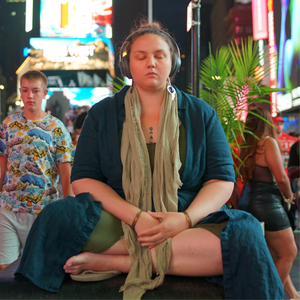
Times Square is my favorite and most well-researched example. Millions of people move through it every day, often carrying a shared intention: to experience something significant. Whether it’s awe, ambition, excitement, or belonging, that collective focus matters. From a physics perspective, repeated synchronized attention creates a stable energetic pattern. Times Square is not sacred because it is quiet or natural; it is sacred because it is overflowing with human presence and movement.
The same can be said of my other favorite monument in NYC, the Empire State Building. When it was built, it became a symbol of economical progress and human tenacity. That type of symbology organizes human consciousness and, over decades, billions of people across the world have held this building in their imagination as a marker of possibility, resilience, and scale.
In biophysical terms, that level of symbolic coherence turns a structure into a nodal point in the collective psyche. That is a modern sacred site.
Researchers working at the intersection of science and subtle systems help bridge this understanding. Veda Austin’s work with water demonstrates how intention and environmental conditions influence physical structure.
Biogeometry was developed to study how shape, proportion, and orientation affect biological energy systems and shows that space itself can support or disrupt coherence. Ancient builders intuited this and modern cities, possibly unintentionally, recreate it.
What distinguishes ancient sacred sites from modern ones is not legitimacy, it's consciousness and human judgement. Ancient cultures deliberately communed with land and yet the mechanism is the same: relationship over time.
A place becomes sacred when it is listened to, returned to, and interacted with in a coherent way. This is how we co-create the future of our human world. Not only through ideas, but through the spaces we inhabit and energize daily.
The invitation, then, is simple and grounded: recognize that the places that are meaningful to you already carry sacred charge. Any given street corner, a park bench, a room where you’ve grieved or dreamed; these are energetic sites because you have cultivated a relationship there. When we learn to commune with land and the subtle energetic fields in a good way, we stop outsourcing sacredness to the past and start participating in it now.
That participation is not mystical escapism or avoidant woo-woo nonsense; it is alignment with the laws of our shared reality... and maybe some inspiration for a different kind of grateful recipeprosity.